

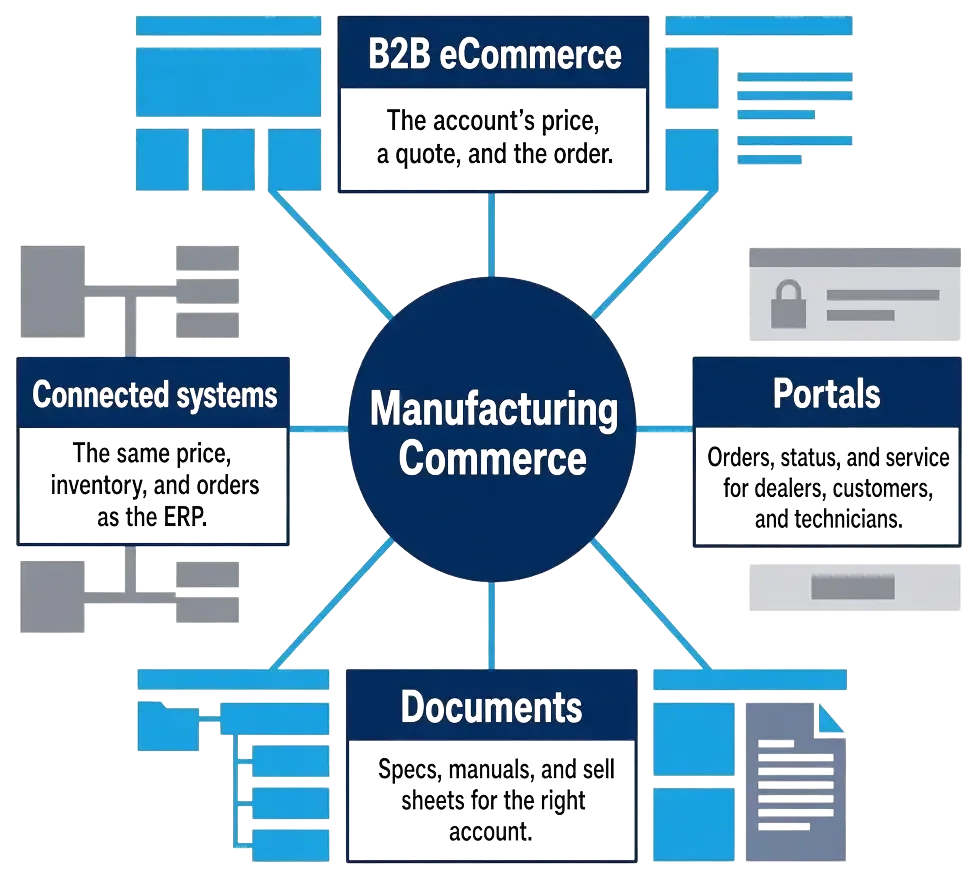
A manufacturer’s B2B site has four primary parts. The account’s price, a quote, and the order. A portal where dealers, customers, and technicians handle orders, status, and service. Specs, manuals, and sell sheets for the right account. A connection that keeps the price, the inventory, and the order the same as the ERP.
When one of those parts is missing, the channel calls. A dealer asks for a price. A quote sits in an inbox. A technician asks for the spec sheet. An order arrives by email and someone keys it in.
The figure shows those four. They are the primary parts of Manufacturing Commerce.
B2B eCommerce
Dealers still call for a price and still email the order when the site shows one public price and one anonymous cart.
A known account should see its price, its terms, and its ship-to. It should be able to request a quote on a product that has to be configured before anyone can price it. It should be able to place an order, repeat one from history, or send a list of lines. Some manufacturers also sell direct, beside the channel. That buyer can use the same site. The account price and the public price are not the same number.
Portals
A shared public site treats the dealer, the customer, and the technician as the same buyer. They are not.
Each of them needs a place to follow an order, see a status, and handle service. The dealer checking an open order, the customer looking up a shipment, and the technician opening a service record are three kinds of work. One catalog page does not cover them.
Documents
The spec, the manual, and the sell sheet are still requests when they live in a single downloads folder, or in someone’s email.
The dealer needs the sheet that helps them sell. The technician needs the manual that matches the product in front of them. Those are different files for different people. The account should be able to reach its own, without calling to ask which one is current.
Connected systems
The site shows one price or one stock position. The ERP has another. The buyer calls to find out which number is real, and the order they email still has to be keyed in so the warehouse can ship it.
Price, inventory, and orders on the site have to match the ERP, which is where the company already quotes and fulfills. When they match, the channel can use the site. When they do not, the site becomes a second place to check.
If this is the site you are being asked for
Excellira builds manufacturing commerce software for this.
Start Here if you want to talk about it.